I notice that an empire – and, consequently, its language – begins to fall when it reveals its true face. It doesn’t have to collapse physically; it probably won’t, not soon, in any case, if we’re being honest with ourselves and history. But at least – and perhaps I shouldn’t say “at least,” because it’s no small thing – you see it for what it is, irreversibly. You draw a line.
It’s this moment that interests me in people’s relationship to language – now.
Speaking a language, then no longer speaking it, and having it send myriads of ants down your spine. Did you love the language in which you read the tales about mermaids on old oak trees? Or maybe it was the oak tree itself — the real one, outside your grandparents’ house — that you loved? But when you see people who speak that language snapping its branches, it feels wrong to go on. So you let the language go. One word at a time, without knowing when you started.
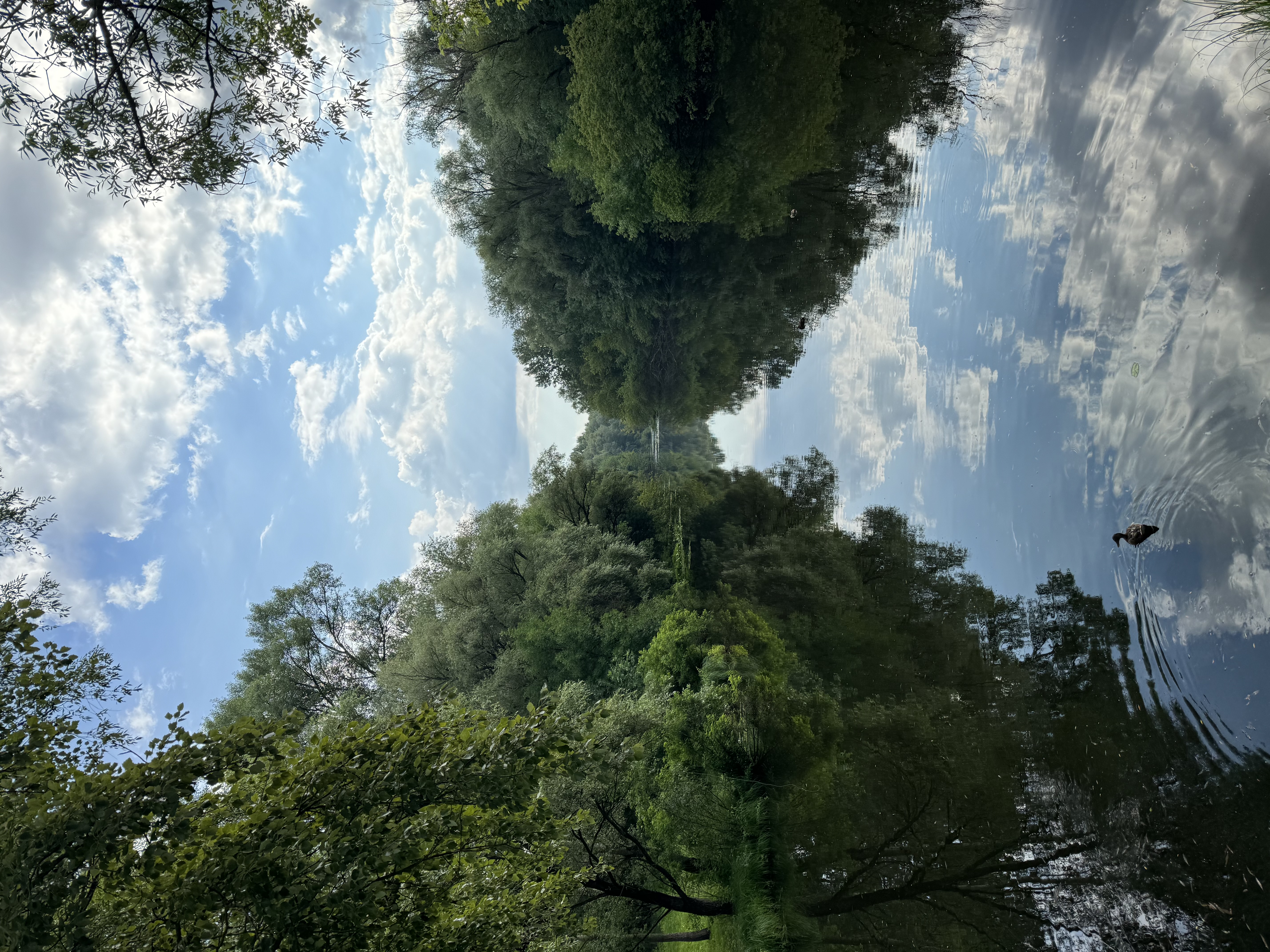
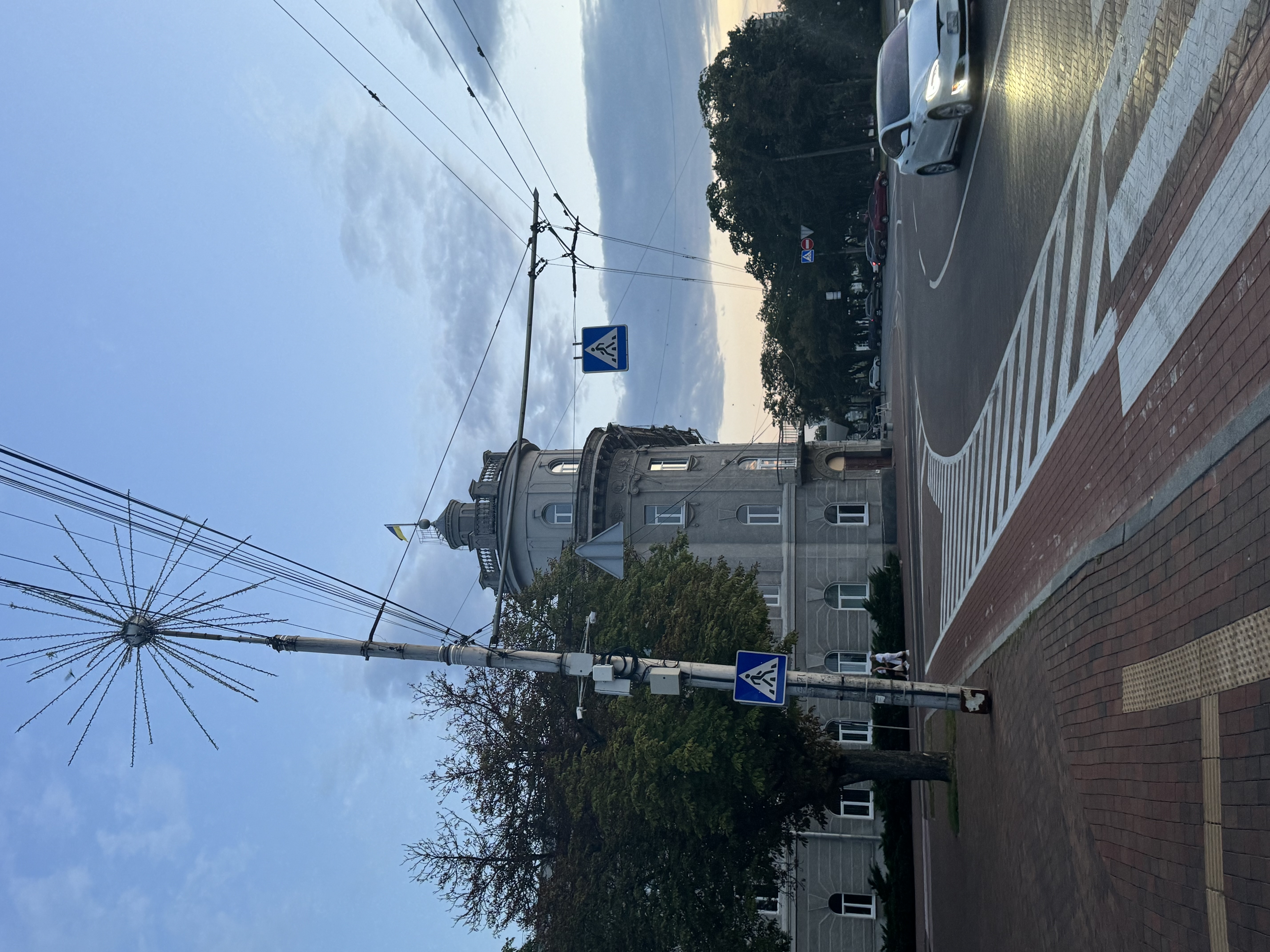
I never used to think the language I spoke mattered. Probably because I was a child. I grew up in Chernihiv, a city with three hundred thousand residents in the northeastern part of Ukraine, in close proximity to the border with both Russia and Belarus – so close, in fact, that a village nearby erected an almost ironic monument to the three ‘brotherly nations.’ I didn’t use to think about the significance of my city’s location; I knew its geographical position meant most of its inhabitants spoke Russian to family and friends as they walked past the fading mosaics on the fences, or through the slightly overlooked yet still charming parks, or into the lush, black forests on the city’s outskirts. But it didn’t seem, then, to mean more than that.
I left the city in 2022, when its proximity to the border made itself known to its residents in a new way; suddenly, it became clear that first and foremost, this closeness signified the closeness of the w-a-r : to each one of us. My mom drove me, my brother, and my grandmother out of the city in the middle of March, when it was still possible to leave; word had gotten out that they were trying to encircle it, so we had to go.
And then followed a long journey I can’t really remember: the mountaintops of Romania, a few stifling hot summer months in Germany, a move to the UK to start twelfth grade. In my new high school, I would speak English all day, only switching to French during French A-level classes, then to Ukrainian and Russian when I called my parents who, after I was settled into high school, had returned to our liberated region.
Having grown up in a city that insisted on balancing the green of its trees and the gray of its multi-level Soviet housing blocks, I was used to balancing languages, too: Ukrainian for general education, French twice a week (which I chose over German as my required second foreign language class), English (mandatory, as it “would be very useful for us in the future,”) and German, once a week, with a tutor. I spoke Russian, too; on the newly painted playgrounds where my friends and I gathered after classes, and in the shops where middle-aged women in dainty medical caps handed me freshly baked whole grain bread. Sometimes I’d hear it on overcrowded buses during rush hour, as a driver struggled to keep from shouting at passengers who just couldn’t hand change back for the love of God, though national law required him to use Ukrainian at all times at his workplace.
My classmates mostly spoke Russian, too. While the Biology teacher, Yulia Mykolaivna, would tell us about the plant cells in her errorless, academic Ukrainian, everyone would quietly gossip in Russian about the new class sweethearts or upcoming school concert. Except for Dima who sat at the wooden desk in front of mine, and always whispered to friends about the very same gossip, but in Ukrainian, as if it were a secret code. And except for Sasha, who was taller than the school roof, and who (like the rest of his family) refused to speak anything but Ukrainian because he was too embarrassed to mispronounce Russian words. I now think that my whole city was like Sasha. Scared to mispronounce Ukrainian words, we would resolve into Russian, English, French, German, or Spanish whenever we could, in order to maintain the facade of a kind of provincial sophistication.
My Ukrainian-born mother spoke Russian to me. Born into a military family, she spent only the first few years of her life in Ukraine before returning there in her twenties. Her father’s position in the military brought the entire family from Rivne in central Ukraine to Baku, in Azerbaijan, and from Baku to Moscow, and onward to a new and distant city every few years. This Soviet cosmopolitanism trained my mother to speak in a language understood in every new place she arrived: Russian. Though she’d gone to college and was more educated than my grandmother (who, born and raised in a village, had no access to university education), my mother never learned to pronounce certain words in Ukrainian, nor write in it. This was, perhaps, the price to pay for her more structured educational experience.
My Russian-born father, in his turn, has only ever spoken Ukrainian to me, and to anyone else who understands it. He had moved to Chernihiv for an administrative job at the Chornobyl power plant — but really, I think he moved because of his growing disdain for the place where he happened to be born. He described his childhood memories as “not free,” and he would sometimes recite Lermontov at our kitchen table with a kind of weary devotion:
“Proshchai, nemytaya Rossiya,
Strana rabov, strana gospod..."
"Farewell, unwashed Russia,
Land of slaves, land of masters..."
He liked translating poems, too, and while he would often ask me to find the English versions of Russian poems he remembered from his school years, he also loved translating these poems into Ukrainian. As my father put it, Ukrainian offered the means to articulate a new and conscious selfhood.
The most ideologically balanced linguistic experience I had was through my maternal grandmother. Born in the 1950s in a tiny village between Ukraine and Belarus, she would go on to live in different parts of the Soviet Union, but she always kept this place – and its languages – in her heart. She spoke Ukrainian with me, Russian with her neighbors, and Belarusian with our relatives. She never talked about Marx, but she liked to talk about God — and about my grandfather, and about Bashkiria, where he was from.
Bashkiria, or Bashkortostan, a Republic within the present-day Russian Federation, is a vast and beautiful place. Twice my grandmother brought me there to visit. Ripe berries grew beside the dilapidated roads that people liked to complain about, whether they were driving on them toward big cities like Ufa, or out toward the always-nearby wilderness, where Bashkirs like to hunt.
My grandmother was as much in love with this country, with its distinct literature and customs, as she was with my grandfather. She would always talk about them – the place and the person – together.
She never got a chance to study formally, but she was obsessed with culture. She read Ukrainian legends, and Chekhov, and Gogol. She read Georgian epic poems, Spanish fables, and Kafka in translation. While she would complain about not speaking any “foreign” language, her bookshelf disagreed.
I still remember reading out loud with her; once we read a Russian short story about a young noblewoman who adores French culture – adores it, that is, until Napoleon’s army approaches her Russian city. And as the young woman stands by the window watching the approaching invasion, she decides – without irony – to change her à la française name, Julie, to a commonly Russian Yulia. She becomes, in that moment, a Russian patriot. Voltaire no longer impresses her.
It wasn’t satire. It was an intimate transformation – if you can describe a turn to Russian nationalism as such. And what stayed with me wasn’t the plot, but the language: the sense that French had made her vanish, and Russian had made her real in that moment, yet both were a kind of performance. Her fascination with French, then, was like a fascination with new fashion; her sudden shift to Russian was, similarly, something inhabited, not owned — less an essence than a reaction to her circumstances, her fear, her trembling, the in-betweenness of the reflection she’d seen of herself in the window that morning; the reflection might have been non-derivative, but the response, later, the recollection and what she made of it — they were all secondary and thus, inevitably, a little bit unreal.
But I myself, for what it was worth, was no better than her. Nor was anyone, I thought. Our memory and our perception are just as flexible. How we choose to present ourselves – both to ourselves and to others – is just as fully within our hands, and just as dependent on our present circumstances, and just as receptive to whatever circumstances may arise. No matter what, I will remember that my grandmother read that short story about the noblewoman to me in Russian, but when she described her own village, she used Ukrainian. My father described Lermontov in Ukrainian, too. Memory, it turns out, is also multilingual, if we're honest with ourselves.
Things were more difficult when it came to language, though. Take, for instance, the ongoing debate over the use of Ukrainian language: where to draw the line — if there even was one — between using Ukrainian or, perhaps, Ukrainian and Russian in everyday life and in the workplace, especially now, under the rockets and the heavy, threatening sky. I kept returning to the polite, almost diplomatic answer people offered: it’s never just about which language you speak, but what you choose to say in it — and why. This middle-ground, not universally accepted but somewhat respected, implied that the heart of the issue wasn’t grammatical, but ethical.
Still, it seemed to me that the answer had to lie in something far more physical above anything else — just like the conditions we were living through. These were real, tangible events happening to me and to her, leaving little room for nuance, offering instead an almost-refreshing clarity. They forced people to leave, left behind traces of what was lost — rooms emptied out, silences where language used to be. And yet, even in its absence, language stayed in the body; every vowel in the language you chose echoed through you a thousand times. Wasn’t that a lot to give of yourself?
Growing up with many languages is beautiful, even when their reasons for coexistence are not. But the meanings of these languages – what they signify, how they feel in your mouth – can, and do, change. They change with time, with war, with borders, with bodies: I feel sympathy for Julie, for Yulia. It’s terrible to have your country invaded. And it seems to me perversely curious to study this uncontested shift from one language to another, to study the number of dots that crown your i, while the physical reality which accompanies the shift is so close and cruel.
I didn’t have my own Julie moment when the invasion began. It came later, like a fog lifting.
The morning of February 24th, in 2022, my mom woke up at 5 a.m. and listened to the Russian news. An hour later (she wanted to let us sleep) she woke my brother and me up, and told us to pack. I didn’t think about the fact that she told us to pack in Russian. It was a mother telling her children to grab their things and go. I grabbed only two books: an old Soviet encyclopedia of world literature, in Russian, and Gombrich’s History of Art, translated from German to English. I didn’t think much when I chose them. Later, I would.
The rockets sounded far away. My mom called them rakiety, in Russian, and sometimes rakety in Ukrainian. The sound the rockets made isn’t a sound that can be articulated with language. It was like the earth split open sideways. I remember standing at the window and thinking of Julie.
That summer I was in Germany, sitting on the floor of a friend’s living room, watching Godard films. I wondered why he referenced Dostoyevsky in every single one. His anti-capitalism made sense. But his unquestioning reverence for a Russian imperialist didn’t. The why I felt then only continued: why did Thomas Mann nominate, for the Nobel Prize, a writer who glorified Russian settler colonialism in Crimea? Why has Noam Chomsky, a linguist who preaches pacifism, deny my country’s right to exist? Why did the Oscars nominate, as best supporting actor from Anora, someone who openly supports the invasion? Why do people who claim to hate empires keep making exceptions for this one?
I asked questions that I didn’t have words for. Language wandered; I wandered with it.
Sometimes I think: I want this language to fall, in my life. Because it makes me hurt. Not just in words — but in the silence between them.
But I know it won’t. Language doesn’t fall like that. It lingers. It stains. It survives in scars, in reflexes, in lullabies you didn’t choose but remember anyway.
Julie became a patriot when her city was on fire. That was the story. That’s how she told it. Others are becoming something else now; people in my country, though their story is different, are also being shaped by a new, more elaborate kind of fire. So many other people in different corners of the world, forced to embody something completely new and unfamiliar due to their own misfortunes, among which they have no choice but to transform.
I don’t know what the answer is – except that those who claim to have it rarely do. Especially when it comes to language.
There’s a difference between a language falling in your life and an empire falling on the world. The first is intimate. The second pretends not to be.
Intimacy means it happens inside you. It reshapes your body from the throat out. It’s in the way your mouth forgets how to form one set of sounds, begins to dream in another. It’s in the name you answer to, and the one you flinch from. In what you whisper to a child at night. Intimacy is how language weaves into who you are before you can separate yourself from it.
But everything changes when you hear a rocket fly past your head. That sound – a sound between a word and a language – is one everyone understands. You don’t need to speak it. It speaks to you. It punctures the narrative. It ends the sentence. It interrupts the story you thought you were in.
Looking back, I can trace my shift to Ukrainian not to that moment, but to the story I told myself about it later. We don’t live through events; we explain them to ourselves later on. And that telling becomes part of the answers we put forward, true or not, about what we think has really happened.
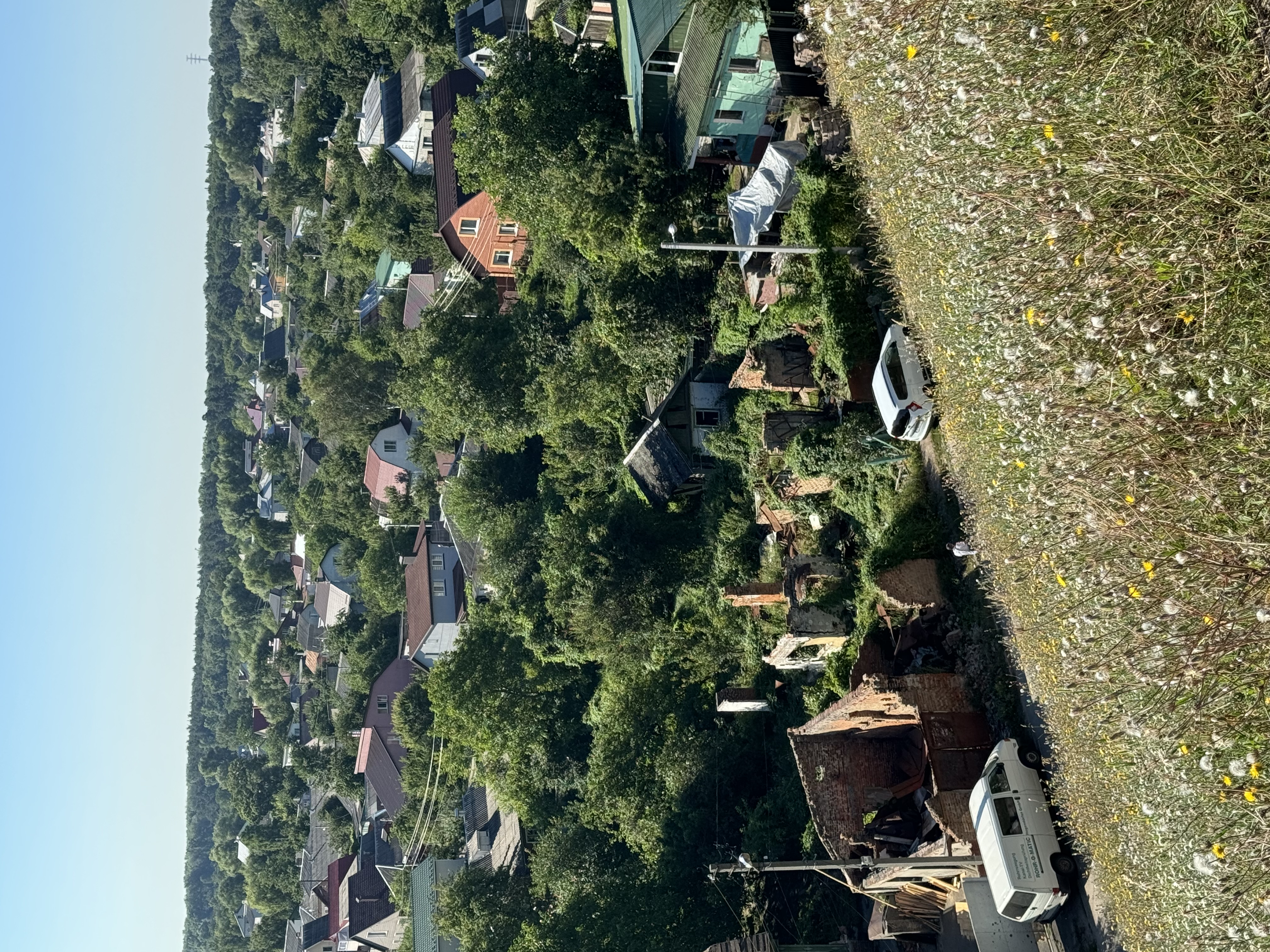
Intimacy has a language. So does fear. So does memory. And sometimes they overlap. Sometimes, you switch languages not because of ideology, but because one language is too heavy all of a sudden.
Underneath Russian, Ukrainian, French, German, there’s something else – a dirt floor at the base of the Tower of Babel. Maybe you watch a rocket fly past your head from that floor.
"1: From a literary fairy tale “Ruslan and Lyudmila” by a 19th century imperial Russian poet Alexander Pushkin
2: One of the most famous poets and novelists of the nineteenth century Russian Empire, Mikhail Lermontov spoke out against his totalitarian government in works like “Farewell, unwashed Russia…”